

Planning & Time Management: Session #7 Recap

Summary:
In our seventh session of the executive functioning skill-building group, we explored planning and time management. These essential skills are vital for managing daily tasks sustainably. Our group provides a supportive environment where participants can engage in ways that best suit their needs. We focus on neurodiversity and support those managing burnout, chronic conditions, or other capacity challenges. In this session, we discussed various strategies, mindset adjustments, and practical tools to enhance time management.
Table of Contents:
- Session Highlights: Planning & Time Management
- Understanding Time Management Challenges
- Capacity Check-In
- Time Management Strategies
- Mindset Adjustments
- Energy-Based Planning
- Addressing Time Blindness
- Prioritization Strategies
- Tools and Technology
- Actionable Steps
- Conclusion
Session Highlights: Planning & Time Management
Understanding Time Management Challenges
We began the session by recognizing the complexities involved in planning and time management. They encompass many skills, such as task sequencing, predicting time demands, prioritization, and adjusting plans. We discussed:
1. Energy and Capacity: Many factors, like burnout or chronic conditions, can impact time management.
2. Variable Attention and Perfectionism: Attention inconsistency can hinder effective planning, as can a strict adherence to perfectionism.
3. Time Blindness: An experience common among neurodivergent individuals, time blindness challenges our perception of the passage of time.
Capacity Check-In
Before implementing strategies, consider conducting a self-assessment of your current capacity:
- What are your energy levels and capacity today?
- How does your capacity influence your planning challenges?
- Are you ready to experiment with new time management strategies? If not, is there a time you expect your capacities to better support the demands of problem solving and implementing new actions?
Time Management Strategies
1. Mindset Adjustments
- Perspective and Perfectionism: Zoom out to gain perspective on tasks. What if a task isn’t completed perfectly? What would the actual consequences likely be? Can you practice with low-stakes tasks?
- Imperfect Planning Practice: Choose low-stakes tasks, and plan imperfect steps. Follow through and reflect on the experience.
2. Energy-Based Planning
- Energy Cycles: Align tasks with your natural energy rhythms.
- Flexible Routines: Build routines that can scale up or down based on your capacity.
- Time Flowing: Dr. Sasha Hamdani teaches us to organize our day around qualitative markers, such as after specific activities, instead of rigid time frames.
3. Addressing Time Blindness
- Make Time Physical: Use visual timers or hourglasses to make the passage of time more tangible.
- Set Reminders Generously: Employ multiple alarms or reminders to remind you of upcoming tasks.
- Buffer Time: Work backwards from deadlines to include adequate buffer time.
Prioritization Strategies
-Tools and Technology: Consider exploring digital tools like Goblin Tools to help prioritize and manage tasks with AI support. They provide external executive function support so you don’t have to expend so much energy prioritizing.
- Eisenhower Matrix: Use it to sort tasks based on importance and urgency, helping you decide what to tackle first.
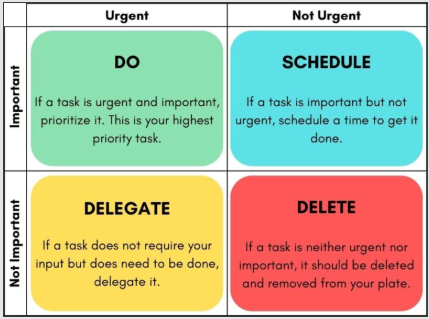
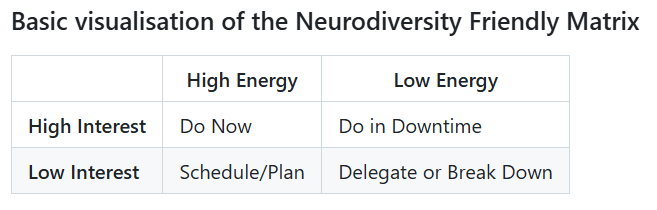
The variables can be changed to be more personalized to your neurotype and motivators, like the following example by Katie M Hughs:
Actionable Steps
Identify a Focus Area: Consider focusing on a particular skill or project where you want to improve your planning and time management.
Explore Tools: Try using visual timers or project management apps to track time and tasks.
Practice Imperfect Planning: Take a low-stakes task and approach it with a good-enough mindset.
Reflect: What happened when you tried this new strategy or tool? Were there changes, however incremental? Did this strategy address one barrier, but others remain? Was there no change or an undesirable result?
Celebrate the fact that you tried something new and gained insight from the experience.
Refine: Take those insights and decide to refine, retain, or release the strategy. What else are you curious to try?
Conclusion
By engaging with these strategies, you can enhance your planning and time management skills within a supportive framework. Joining our group allows for deeper exploration of such strategies and offers personalized guidance tailored to your strengths and challenges. Stay tuned for our on demand videos. Embrace this compassionate approach to infuse more intention and control into your daily life.
Join us next week as we focus on maintaining habits and persevering over time. Together, let's continue building a life filled with more ease and satisfaction.