
Heal Burnout, Expand Capacity: Session #4 Recap
In this week's session of our Executive Functioning Group, we delved into burnout and capacity management. Held in a supportive environment, participants are encouraged to engage in ways that feel authentic and safe, whether through voice, chat, or quiet listening. Our guiding motto continues to be "no shame, no pressure," fostering a neurodiversity-affirming space attentive to varied personal capacities.
Key Topics Covered:
Understanding Burnout and Capacity
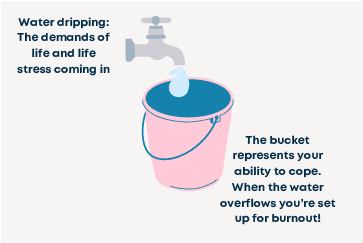
We began with a deep dive into understanding burnout — especially as it relates to neurodivergent individuals. Burnout is identified as a state where life’s demands continually exceed one’s capacity, often resulting in chronic fatigue, fluctuating attention spans, and even a loss of personal skills, particularly for neurodivergent individuals. Dr. Megan Anna Neff uses a metaphor for burnout of a bucket (your capacity) and faucet (life’s demands). Burnout occurs when the bucket is constantly overflowing. Therefore, burnout recovery and prevention is framed in terms of expanding your bucket and reducing your faucet’s flow.
Reduce your faucet: Actionable Insights for reducing demands
1. Social Support and Engagement:
- Identify social interactions that recharge rather than deplete energy. Consider strategic withdrawal from overwhelming situations when necessary, and seek communities that understand and support neurodivergent and disabled experiences.
2. Mindful Outsourcing:
- Engage in skill trades, like helping a friend with their needs in exchange for assistance with your own. Simplify routines based on energy levels, allowing for flexibility and self-compassion on low-capacity days.
3. Addressing Environmental and Sensory Needs:
- Use tools like noise-canceling headphones or sensory-friendly environments to manage sensory overload. Recognize the importance of adjusting environments to better suit your sensory processing needs.
Expand your bucket: Actionable Insights for increasing capacity
I recommend starting your burnout recovery journey with reducing demands, as these strategies are concrete, often don’t take too much effort to implement, and create space for capacity expansion in and of themselves. When your faucet has been reduced to some degree, and you have the ability to build some new healthy habits, then you’re ready to more directly expand your bucket with long-term self (and us-) care.
1. Multi-dimensional rest:
- It’s easier said than done, when many of us have multiple responsibilities and unreasonable productivity expectations from work and culture. Despite this, most of us could still create more space for rest. Start with an inventory of what aspects of yourself are depleted and explore (perhaps with the support of a friend or therapist) how you can create space to rest. For example, social depletion may require limiting social media engagement, mindful hermiting time, or taking yourself on solo artist’s dates. Sensory over-stimulation may require regular sensory breaks. This could mean trying out a float tank, walking in a park, or creating a quiet corner in your home where you can lay down with a light blocking mask, noise-canceling headphones, and a weighted blanket for 15 minutes a day.
2. Lean into Strengths:
- Burnout can make it feel like we’re dragging ourselves through our days, and we lose touch with our passions and intrinsic motivations. Try to embrace deep interests and personal strengths as a path to regain motivation and capacity.
3. Nervous System Regulation and Energy Management:
- Experiment with practices such as bilateral stimulation for managing stress and aiding relaxation before bed. Check out my blog post for examples and tailor these practices to suit personal preferences and contexts.
4. Back to basics:
- What baby steps can you take to prioritize your foundational wellness practices: Getting quality sleep and nourishing your body with consistent, manageable nutrition and exercise. Seek support to build healthy habits and rituals.
Practical Application: Grading Habits
We introduced the concept of "grading" activities (like you grade a road to be more or less steep) as a method to maintain habits flexibly according to daily capacity levels. Whether it’s incorporating short bursts of exercise or simplifying household tasks on low-capacity days, this technique encourages consistency without overwhelm. We will apply grading in more detail in sessions 8 & 9, Perseverance: Making Habits Last.
Depression and Burnout
Important note: When experiencing depression, part of healing involves behavioral activation, using strategies like Opposite Action in Dialectical Behavioral Therapy (DBT), wherein you consciously act an opposition of depressive impulses (e.g. I want to isolate myself and stay in bed all day, but moving my body and talking to a trusted friend will actually help me to feel better). With burnout, it’s not as straightforward. Your system is depleted and you need real rest: Often not just sleep, but less cognitive, social, emotional, and physical demands.Burnout and depression have similar signs and can co-occur, so this can be complicated. A simple rule of thumb is to bring attention to how you feel in response to different activities. For example, if you *hated* the idea of going for a walk, but then felt a little better (or even the same) after, it’s a good sign that your system needs more activity. If that walk left you more depleted, you may be in need of more rest. Your body has the answers, and learning to listen is an important part of healing. If you are questioning whether you’re experiencing burnout and/or depression, please reach out for support from your community and a support group and/or therapist to help you navigate this tough time.
Community Insights
Dialogue was rich with participant experiences, highlighting the realities of living with burnout and tools for recovery. Participants shared personal insights, with several noting feelings of overstimulation and challenges in balancing overwhelming demands and maintaining creative pursuits. Engaging discussions on unmasking practices revealed the complexity and personal nature of reducing social demands while maintaining authenticity in less demanding environments.
Looking Ahead: Action Steps
To apply these insights, participants are encouraged to identify one daily habit they wish to sustain and explore how it can be "graded" to fit varying capacity levels. Additionally, exploring tools like bilateral stimulation or outsourcing demands to enhance personal well-being and recovery from burnout.
Join Our Next Session
We invite you to keep these insights in mind as you reflect on your own experiences with capacity and burnout, and we look forward to supporting you on this journey.
Join our group live or stay tuned for our on demand videos. We will continue to explore these themes and equip ourselves with tools and strategies tailored to our unique journeys. Together, we can infuse more ease and flow into everyday tasks, paving the way for a more harmonious relationship with our capabilities and responsibilities.